

When Does a Novel Actually Feel Finished?
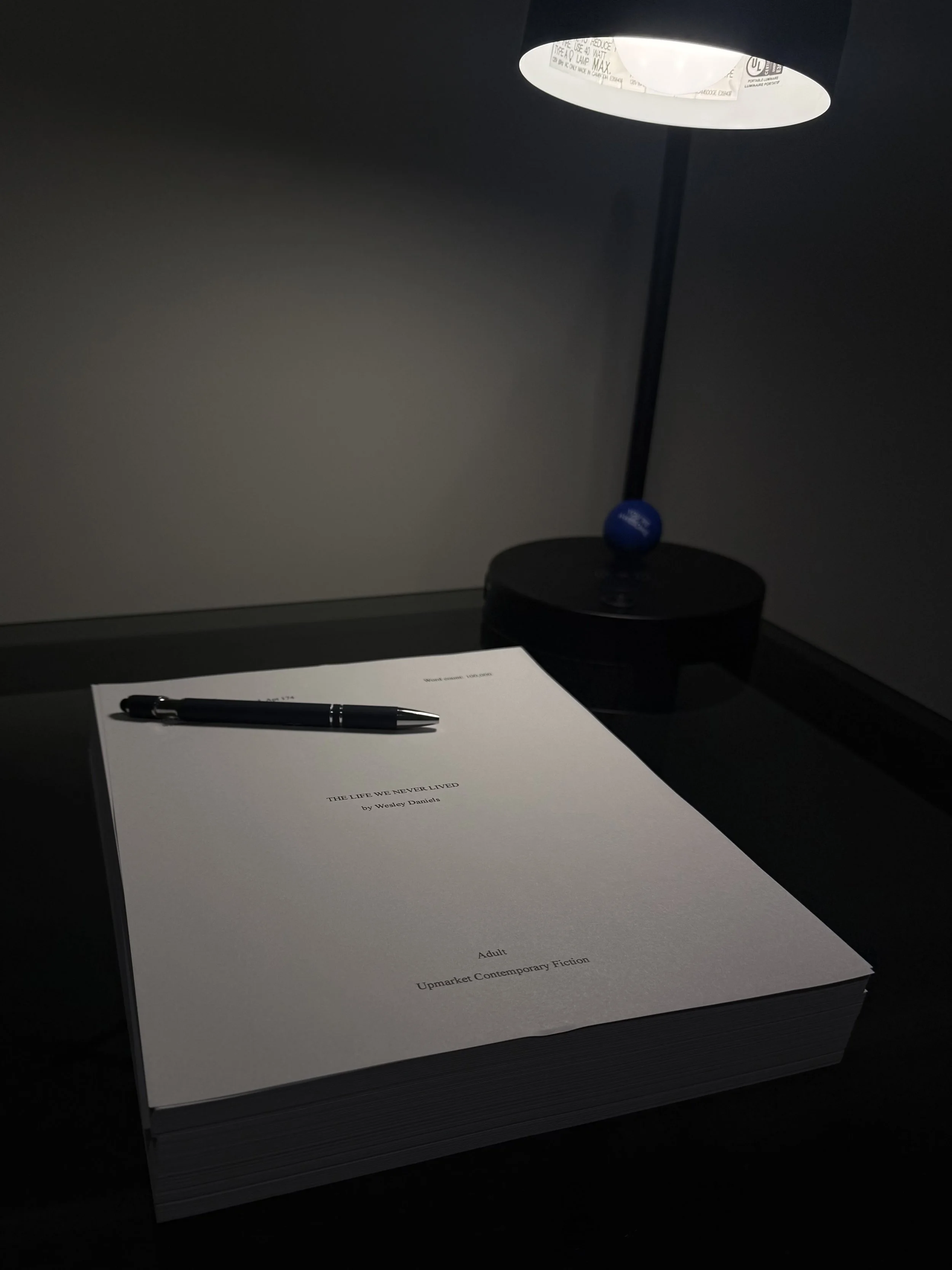
I have declared The Life We Never Lived finished more than once. This has not, historically, prevented me from opening the manuscript again.
There is always another sentence.
Another transition.
Another chapter you suddenly wonder about at midnight.
Another moment where you think, Maybe this would be better if…
Writing a first draft taught me how difficult it is to write a novel. Revising one taught me something arguably worse: A novel can always be changed. That's different from saying it can always be improved. Learning the difference has become one of the final challenges of writing this book.
There were stages when The Life We Never Lived clearly wasn't finished. Some scenes were summarized when they needed to be dramatized. Characters needed more dimension. Certain revelations needed stronger foundations earlier in the book. Emotional moments were sometimes being explained after the scene had already made them clear.
Those were problems.
Revision made the manuscript better. But eventually the problems become smaller. You're no longer asking whether a character's motivation works. You're wondering whether one paragraph should move three paragraphs earlier. You're no longer rebuilding a chapter. You're changing a word, changing it back, reading the sentence aloud, changing it again, and eventually realizing the original word may have been fine.
That's where revision becomes dangerous.
There is a point at which changing a manuscript can become less about improving the novel and more about relieving the anxiety of letting it go.
I understand that impulse now.
As long as I'm editing The Life We Never Lived, it isn't finished. And if it isn't finished, nobody can judge the finished version. Revision can become a very sophisticated form of hiding.
I've also discovered that familiarity distorts your judgment. Read the same scene enough times and even a perfectly good sentence starts sounding strange. A joke stops being funny because you've read it thirty times. An emotional moment stops affecting you because you know every word that's coming. That doesn't necessarily mean the writing stopped working. It may simply mean you're no longer capable of experiencing it as a reader.
That's where distance—and other readers—becomes essential.
I'm trying to develop a better test for revisions now. Not: Can I change this? Of course I can. Instead: What problem am I solving?
If I can identify the problem, I'll work on it. If I can't explain what the change improves, I'm increasingly inclined to leave the sentence alone. That sounds obvious, but it hasn't been.
There is also a difference between polishing and protecting. Some roughness belongs in a novel. Characters don't always speak elegantly. Emotional moments aren't always symmetrical. Not every question needs an answer. Not every scene needs a concluding sentence explaining what it meant. In fact, one of my goals during later revisions has been removing some of those conclusions.
Trusting the scene.
Trusting the character.
Trusting the reader.
Maybe finishing a novel requires extending some of that trust to yourself.
I don't know whether a novel ever feels completely finished to the person who wrote it. I'm beginning to suspect it doesn't. Maybe eventually the question changes. Instead of asking: Is there anything else I could change? You ask: Is this finally the story I meant to tell?
I'm getting much closer to being able to answer yes to the second one. And when I can, I think that's going to have to be enough.
